according to contract law, every valid contract is also what?
Affiliate 8 Introduction to Contract Police force
Learning Objectives
After reading this chapter, you should understand the following:
- Why and how contract police force has developed
- What a contract is
- What topics will be discussed in the contracts chapter of this book
- What the sources of contract law are
- How contracts are classified (bones taxonomy)
8.1 General Perspectives on Contracts
Learning Objectives
- Explicate contract law's cultural roots: how it has evolved as capitalism has evolved.
- Empathise that contracts serve essential economic purposes.
- Ascertain contract.
- Understand the basic issues in contract law.
The Role of Contracts in Modern Club
Contract is probably the most familiar legal concept in our society because it is and so central to the essence of our political, economical, and social life. In common parlance, contract is used interchangeably with agreement, bargain, undertaking, or deal. Whatever the word, the concept information technology embodies is our notion of freedom to pursue our ain lives together with others. Contract is central because it is the means by which a costless club orders what would otherwise be a jostling, frenetic anarchy.
So commonplace is the concept of contract—and our freedom to make contracts with each other—that information technology is difficult to imagine a time when contracts were rare, when people's everyday associations with 1 another were non freely determined. Yet in historical terms, it was not and so long ago that contracts were rare, entered into if at all by very few: that affairs should be ordered based on mutual assent was generally unknown. In primitive societies and in feudal Europe, relationships among people were largely fixed; traditions spelled out duties that each person owed to family unit, tribe, or manor. People were built-in into an ascribed position—a condition (not dissimilar the degree system still existing in India)—and social mobility was limited. Sir Henry Maine, a nineteenth-century British historian, wrote that "the movement of the progressive societies has…been a move from status to contract."Sir Henry Maine, Aboriginal Law (1869), 180–82. This motion was not accidental—information technology developed with the emerging industrial gild. From the fifteenth to the nineteenth century, England evolved into a booming mercantile economy, with flourishing trade, growing cities, an expanding monetary organization, the commercialization of agronomics, and mushrooming manufacturing. With this evolution, contract law was created of necessity.
Contract constabulary did non develop according to a conscious plan, however. It was a response to changing atmospheric condition, and the judges who created it oft resisted, preferring the imagined quieter pastoral life of their forefathers. Not until the nineteenth century, in both the United States and England, did a total-fledged law of contracts arise together with, and help create, modern commercialism.
Modern capitalism, indeed, would non be possible without contract police force. So it is that in planned economies, like those of the former Soviet Marriage and precapitalistic China, the contract did non determine the nature of an economical transaction. That transaction was kickoff set forth past the land'southward planning authorities; only thereafter were the predetermined provisions set downward in a written contract. Modern capitalism has demanded new contract regimes in Russia and China; the latter adopted its Revised Contract Law in 1999.
Contract constabulary may exist viewed economically as well as culturally. In An Economical Assay of Law, Judge Richard A. Posner (a former University of Chicago police force professor) suggests that contract law performs three meaning economical functions. First, it helps maintain incentives for individuals to commutation appurtenances and services efficiently. 2nd, information technology reduces the costs of economic transactions considering its very being means that the parties need non go to the trouble of negotiating a variety of rules and terms already spelled out. 3rd, the law of contracts alerts the parties to troubles that have arisen in the past, thus making information technology easier to plan the transactions more intelligently and avoid potential pitfalls.Richard A. Posner, Economic Assay of Constabulary (New York: Aspen, 1973).
The Definition of Contract
As usual in the law, the legal definition of contractA legally enforceable set of promises. is formalistic. The Restatement (Second) of Contracts (Department i) says, "A contract is a promise or a gear up of promises for the breach of which the constabulary gives a remedy, or the performance of which the police force in some mode recognizes as a duty." Similarly, the Uniform Commercial Code says, "'Contract' means the total legal obligation which results from the parties' agreement equally affected by this Human activity and any other applicable rules of law."Compatible Commercial Code, Section ane-201(eleven). As operational definitions, these two are circular; in result, a contract is defined every bit an understanding that the police force will agree the parties to.
Almost simply, a contract is a legally enforceable promise. This implies that non every hope or agreement creates a binding contract; if every hope did, the simple definition set out in the preceding sentence would read, "A contract is a hope." Just—again—a contract is non simply a promise: information technology is a legally enforceable promise. The law takes into business relationship the fashion in which contracts are made, past whom they are made, and for what purposes they are made. For example, in many states, a wager is unenforceable, even though both parties "milk shake" on the bet. We volition explore these bug in the chapters to come.
Overview of the Contracts Affiliate
Although contract law has many wrinkles and nuances, it consists of 4 primary inquiries, each of which volition exist taken upwardly in subsequent capacity:
-
Did the parties create a valid contract? Four elements are necessary for a valid contract:
- Mutual assent (i.eastward., offer and credence), Affiliate nine "The Agreement"
- Existent assent (no duress, undue influence, misrepresentation, mistake, or incapacity), Chapter 10 "Real Assent"
- Consideration, Chapter eleven "Consideration"
- Legality, Chapter 12 "Legality"
- What does the contract mean, and is information technology in the proper grade to carry out this meaning? Sometimes contracts need to be in writing (or evidenced by some writing), or they can't exist enforced. Sometimes information technology isn't articulate what the contract means, and a court has to effigy that out. These problems are taken up in Affiliate 13 "Class and Meaning".
- Do persons other than the contracting parties accept rights or duties under the contract? Can the correct to receive a benefit from the contract be assigned, and can the duties be delegated so that a new person is responsible? Can persons non a party to the contract sue to enforce its terms? These questions are addressed in Chapter 14 "Third-Party Rights".
- How do contractual duties terminate, and what remedies are available if a party has breached the contract? These issues are taken up in Affiliate 15 "Discharge of Obligations" and Chapter xvi "Remedies".
Together, the answers to these four basic inquiries determine the rights and obligations of contracting parties.
Fundamental Takeaway
Contract law developed when the strictures of bullwork dissipated, when a person's position in lodge came to exist adamant past personal choice (by mutual understanding) and not by status (past how a person was born). Capitalism and contract constabulary have developed together, because having choices in lodge ways that people decide and concur to practice things with and to each other, and those agreements bind the parties; the agreements must be enforceable.
Exercises
- Why is contract law necessary in a society where a person's condition is not predetermined by nascence?
- Contract law serves some economic functions. What are they?
eight.2 Sources of Contract Law
Learning Objectives
- Understand that contract law comes from two sources: judges (cases) and legislation.
- Know what the Restatement of Contracts is.
- Recognize the Convention on Contracts for the International Sale of Goods.
The most of import sources of contract law are state example law and state statutes (though there are likewise many federal statutes governing how contracts are fabricated by and with the federal government).
Case Police
Law fabricated by judges is called instance lawConstabulary decided by judges as recorded in cases and published. . Considering contract law was made up in the common-law courtroom by individual judges equally they applied rules to resolve disputes before them, it grew over time to formidable proportions. Past the early twentieth century, tens of thousands of contract disputes had been submitted to the courts for resolution, and the published opinions, if collected in one identify, would have filled dozens of bookshelves. Clearly this mass of material was too unwieldy for efficient use. A like problem also had developed in the other leading branches of the mutual police.
Disturbed by the profusion of cases and the resulting dubiousness of the law, a grouping of prominent American judges, lawyers, and police teachers founded the American Law Found (ALI) in 1923 to attempt to clarify, simplify, and improve the law. One of the ALI'south first projects, and ultimately one of its most successful, was the drafting of the Restatement of the Law of ContractsAn organized codification of the mutual law of contracts. , completed in 1932. A revision—the Restatement (2d) of Contracts—was undertaken in 1964 and completed in 1979. Hereafter, references to "the Restatement" pertain to the Restatement (Second) of Contracts.
The Restatements—others exist in the fields of torts, agency, conflicts of laws, judgments, property, restitution, security, and trusts—are detailed analyses of the decided cases in each field. These analyses are made with an eye to discerning the various principles that have emerged from the courts, and to the maximum extent possible, the Restatements declare the police as the courts have determined it to be. The Restatements, guided by a reporter (the manager of the project) and a staff of legal scholars, go through several so-chosen tentative drafts—sometimes every bit many as 15 or twenty—and are screened by diverse committees within the ALI earlier they are eventually published as final documents.
The Restatement (2nd) of Contracts won prompt respect in the courts and has been cited in innumerable cases. The Restatements are not administrative, in the sense that they are non bodily judicial precedents; simply they are nonetheless weighty interpretive texts, and judges oftentimes look to them for guidance. They are as close to "black letter" rules of law as exist anywhere in the American common-police force legal organization.
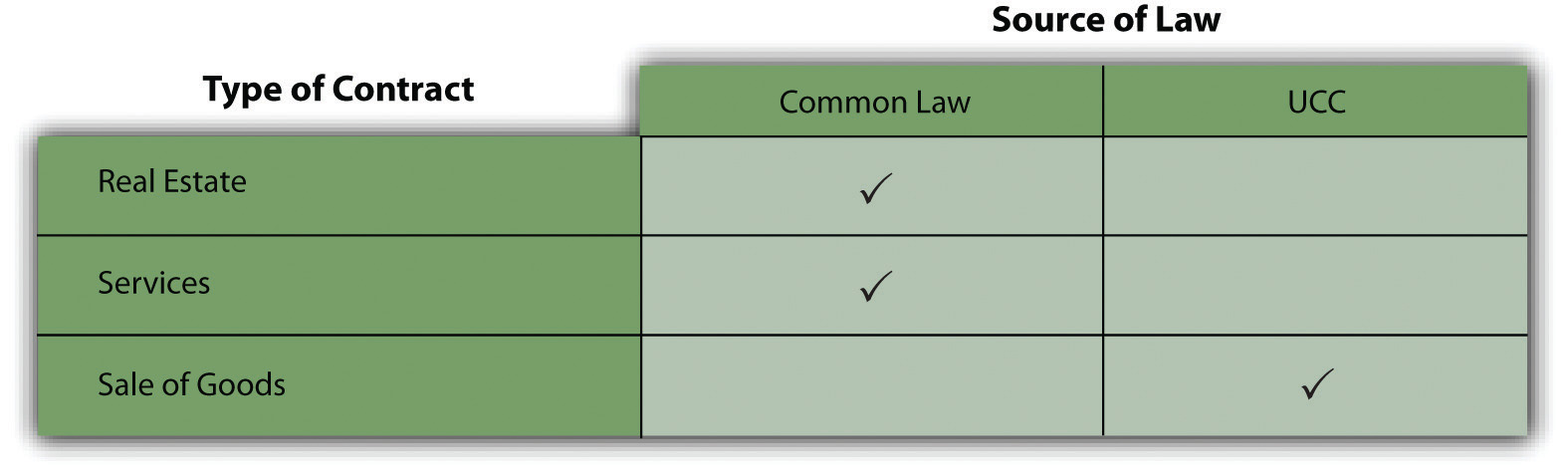
Common law, case police (the terms are synonymous), governs contracts for the sale of real estate and services. "Services" refer to acts or deeds (like plumbing, drafting documents, driving a car) as opposed to the sale of belongings.
Statutory Police: The Uniform Commercial Code
Common-law contract principles govern contracts for real estate and services. Because of the historical development of the English language legal system, contracts for the sale of appurtenances came to be governed by a different torso of legal rules. In its modern American manifestation, that body of rules is an of import statute: the Compatible Commercial Code (UCC)The modern American country statutory law governing commercial transactions. , especially Article iiThat part of the Compatible Commercial Code dealing with the sale of appurtenances. , which deals with the sale of goods.
History of the UCC
A bit of history is in club. Before the UCC was written, commercial law varied, sometimes greatly, from land to state. This first proved a nuisance and and so a serious impediment to business organization as the American economy became nationwide during the twentieth century. Although there had been some uniform laws concerned with commercial deals—including the Uniform Sales Act, outset published in 1906—few were widely adopted and none nationally. As a effect, the law governing sales of goods, negotiable instruments, warehouse receipts, securities, and other matters crucial to doing business organization in an industrial market place economy was a crazy quilt of untidy provisions that did not mesh well from state to land.
The UCC is a model law adult by the ALI and the National Conference of Commissioners on Compatible Land Laws; it has been adopted in one course or another by the legislatures in all l states, the Commune of Columbia, and the American territories. It is a "national" law not enacted past Congress—it is not federal constabulary but uniform land police.
Initial drafting of the UCC began in 1942 and was x years in the making, involving the efforts of hundreds of practicing lawyers, law teachers, and judges. A final draft, promulgated by the ALI, was endorsed past the American Bar Clan and published in 1951. Various revisions followed in different states, threatening the uniformity of the UCC. The ALI responded by creating a permanent editorial board to oversee future revisions. In one or another of its various revisions, the UCC has been adopted in whole or in part in all American jurisdictions. The UCC is at present a bones law of relevance to every business and business lawyer in the United States, even though it is not entirely uniform because different states accept adopted information technology at various stages of its evolution—an evolution that continues all the same.
Organization of the UCC
The UCC consists of ix major substantive articles; each deals with separate though related subjects. The articles are as follows:
- Commodity ane: General Provisions
- Article 2: Sales
- Commodity 2A: Leases
- Article iii: Commercial Paper
- Article four: Depository financial institution Deposits and Collections
- Article 4A: Funds Transfers
- Article 5: Letters of Credit
- Article 6: Bulk Transfers
- Article 7: Warehouse Receipts, Bills of Lading, and Other Documents of Title
- Article viii: Investment Securities
- Article 9: Secured Transactions
Article 2 deals only with the sale of goods, which the UCC defines as "all things…which are movable at the fourth dimension of identification to the contract for sale other than the coin in which the price is to be paid."Uniform Commercial Lawmaking, Department 2-105. The just contracts and agreements covered by Article ii are those relating to the present or futurity sale of goods.
Article 2 is divided in turn into six major parts: (1) Form, Formation, and Readjustment of Contract; (ii) General Obligation and Construction of Contract; (3) Title, Creditors, and Proficient Religion Purchasers; (4) Performance; (5) Breach, Repudiation, and Excuse; and (half-dozen) Remedies.
Effigy 8.ane Sources of Law
International Sales Law
The Convention on Contracts for the International Sale of Appurtenances
A Convention on Contracts for the International Sale of Appurtenances (CISG)An international body of contract police. was canonical in 1980 at a diplomatic conference in Vienna. (A convention is a preliminary agreement that serves as the basis for a formal treaty.) The CISG has been adopted by more than twoscore countries, including the United States.
The CISG is significant for three reasons. Outset, it is a uniform constabulary governing the sale of goods—in result, an international Uniform Commercial Code. The major goal of the drafters was to produce a uniform law acceptable to countries with dissimilar legal, social, and economic systems. 2nd, although provisions in the CISG are generally consistent with the UCC, there are significant differences. For example, under the CISG, consideration (discussed in Chapter eleven "Consideration") is non required to form a contract, and there is no Statute of Frauds (a requirement that certain contracts be evidenced past a writing). Third, the CISG represents the kickoff endeavor by the US Senate to reform the individual constabulary of business through its treaty powers, for the CISG preempts the UCC. The CISG is non mandatory: parties to an international contract for the sale of goods may choose to take their agreement governed by different law, perhaps the UCC, or perhaps, say, Japanese contract law. The CISG does non apply to contracts for the sale of (1) ships or shipping, (2) electricity, or (iii) appurtenances bought for personal, family, or household use, nor does it apply (4) where the political party furnishing the goods does so simply incidentally to the labor or services part of the contract.
Key Takeaway
Judges accept made contract constabulary over several centuries by deciding cases that create, extend, or modify the developing rules affecting contract germination, performance, and enforcement. The rules from the cases have been abstracted and organized in the Restatements of Contracts. To facilitate interstate commerce, contract law for many commercial transactions—especially the sale of goods—not traditionally within the purview of judges has been developed by legal scholars and presented for the states to adopt as the Uniform Commercial Code. There is an coordinating Convention on Contracts for the International Sale of Goods, to which the The states is a party.
Exercises
- How do judges make contract law?
- What is the Restatement of the Law of Contracts, and why was information technology necessary?
- Why was the Uniform Commercial Code developed, and by whom?
- Who adopts the UCC equally governing law?
- What is the Convention on Contracts for the International Sale of Goods?
8.3 Basic Taxonomy of Contracts
Learning Objectives
- Empathise that contracts are classified co-ordinate to the criteria of explicitness, mutuality, enforceability, and caste of completion and that some noncontract promises are nevertheless enforceable under the doctrine of promissory estoppel.
- Keep your eyes (and ears) alert to the use of suffixes (give-and-take endings) in legal terminology that limited relationships between parties.
Some contracts are written, some oral; some are explicit, some not. Because contracts can be formed, expressed, and enforced in a multifariousness of means, a taxonomy of contracts has adult that is useful in grouping together like legal consequences. In full general, contracts are classified along 4 different dimensions: explicitness, mutuality, enforceability, and degree of completion. Explicitness is the caste to which the agreement is manifest to those non political party to it. Mutuality takes into account whether promises are given by two parties or only 1. Enforceability is the degree to which a given contract is binding. Completion considers whether the contract is yet to exist performed or whether the obligations have been fully discharged past i or both parties. We will examine each of these concepts in plow.
Explicitness
Express Contract
An limited contractA contract in words, orally or in writing. is ane in which the terms are spelled out directly. The parties to an express contract, whether it is written or oral, are conscious that they are making an enforceable agreement. For example, an understanding to purchase your neighbour's automobile for $v,500 and to have title adjacent Monday is an express contract.
Implied Contract (Implied in Fact)
An implied contractA contract that is not expressed but is inferred from the deportment of the parties. is one that is inferred from the actions of the parties. When parties accept not discussed terms, an unsaid contract exists if information technology is articulate from the behave of both parties that they intended in that location be i. A delicatessen patron who asks for a turkey sandwich to become has fabricated a contract and is obligated to pay when the sandwich is made. By ordering the food, the patron is implicitly like-minded to the toll, whether posted or non.
The stardom between limited and implied contracts has received a caste of notoriety in the and then-called palimony cases, in which one member of an unmarried couple seeks a segmentation of property afterward a long-standing live-together relationship has broken up. When a married couple divorces, their legal marriage contract is dissolved, and financial rights and obligations are spelled out in a huge body of domestic relations statutes and judicial decisions. No such laws exist for unmarried couples. However, nigh one-third of u.s. recognize common-law marriage, under which ii people are accounted to be married if they live together with the intent to be married, regardless of their failure to accept obtained a license or gone through a ceremony. Although in that location is no actual contract of spousal relationship (no license), their behavior implies that the parties intended to be treated as if they were married.
Quasi-Contract
A quasi-contract (implied in law)A contract imposed on a party when in that location was none, to avoid unjust enrichment. is—unlike both limited and unsaid contracts, which embody an bodily understanding of the parties—an obligation said to be "imposed by law" in guild to avoid unjust enrichment of one person at the expense of another. A quasi-contract is non a contract at all; information technology is a fiction that the courts created to prevent injustice. Suppose, for instance, that the local lumberyard mistakenly delivers a load of lumber to your house, where you are repairing your deck. It was a neighbor on the adjacent block who ordered the lumber, but you are happy to take the load for free; since you never talked to the lumberyard, y'all figure y'all need non pay the bill. Although it is true there is no contract, the police implies a contract for the value of the material: of course you will take to pay for what you got and took. The existence of this unsaid contract does not depend on the intention of the parties.
Mutuality
Bilateral Contract
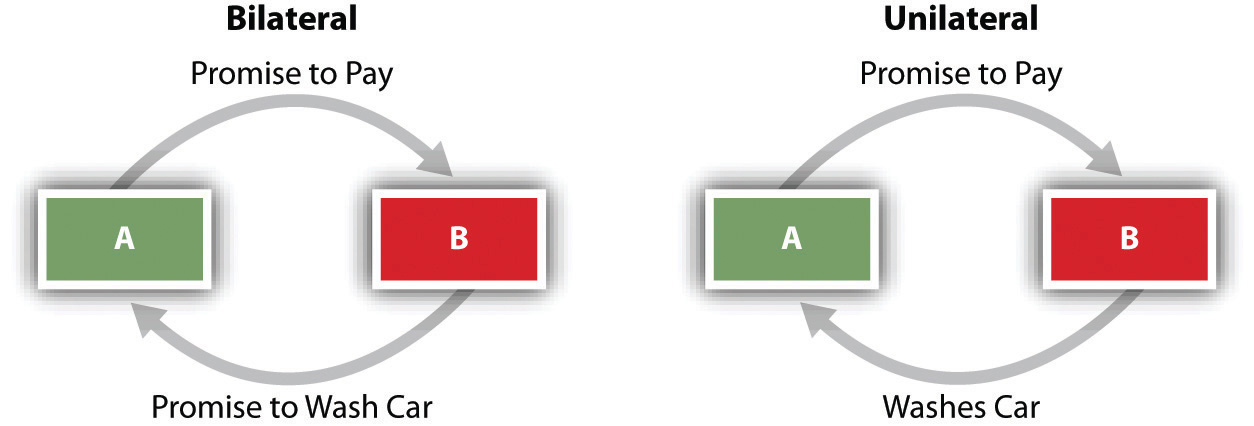
The typical contract is one in which the parties brand common promises. Each is both promisor and promisee; that is, each pledges to exercise something, and each is the recipient of such a pledge. This type of contract is chosen a bilateral contractA contract in which each party makes a hope to the other. .
Unilateral Contract
Mutual promises are not necessary to plant a contract. Unilateral contractsA contract that is accepted by functioning of the requested action, not by a promise. , in which one political party performs an act in exchange for the other party'southward promise, are every bit valid. An offer of a advantage—for catching a criminal or for returning a lost cat—is an example of a unilateral contract: there is an offer on ane side, and the other side accepts past taking the action requested.
Figure 8.ii Bilateral and Unilateral Contracts
Enforceability
Void
Non every agreement betwixt ii people is a bounden contract. An understanding that is lacking one of the legal elements of a contract is said to be a void contractAn understanding that never was a contract. —that is, not a contract at all. An agreement that is illegal—for example, a promise to commit a crime in return for a money payment—is void. Neither political party to a void "contract" may enforce information technology.
Voidable
By contrast, a voidable contractA contract that is capable of being annulled. is one that may become unenforceable by one political party just tin be enforced by the other. For example, a pocket-sized (whatever person under 18, in almost states) may "avert" a contract with an adult; the adult may non enforce the contract confronting the small if the small refuses to comport out the deal. But the adult has no choice if the minor wishes the contract to be performed. (A contract may be voidable by both parties if both are minors.)
Usually, the parties to a voidable contract are entitled to be restored to their original condition. Suppose you lot agree to buy your seventeen-twelvemonth-one-time neighbor'southward car. He delivers it to you in commutation for your agreement to pay him adjacent calendar week. He has the legal correct to terminate the deal and recover the car, in which case you will of course take no obligation to pay him. If you lot accept already paid him, he however may legally demand a return to the condition quo dues (previous situation). You must return the car to him; he must return the cash to yous.
A voidable contract remains a valid contract until it is voided. Thus a contract with a minor remains in force unless the minor decides he or she does not wish to be leap by it. When the minor reaches majority, he or she may "ratify" the contract—that is, concord to be leap by it—in which case the contract will no longer exist voidable and will thereafter be fully enforceable.
Unenforceable
An unenforceable contractA contract for which the nonbreaching party has no remedy for its breach. is 1 that some rule of constabulary confined a court from enforcing. For example, Tom owes Pete money, but Pete has waited too long to collect it and the statute of limitations has run out. The contract for repayment is unenforceable and Pete is out of luck, unless Tom makes a new promise to pay or actually pays part of the debt. (However, if Pete is holding collateral equally security for the debt, he is entitled to keep information technology; not all rights are extinguished because a contract is unenforceable.) A debt becomes unenforceable, too, when the debtor declares bankruptcy.
A flake more on enforceability is in order. A promise or what seems to exist a hope is commonly enforceable merely if information technology is otherwise embedded in the elements necessary to make that promise a contract. Those elements are common assent, existent assent, consideration, capacity, and legality. Sometimes, though, people say things that seem like promises, and on which another person relies. In the early twentieth century, courts began, in some circumstances, to recognize that insisting on the beingness of the traditional elements of contract to make up one's mind whether a promise is enforceable could work an injustice where at that place has been reliance. Thus adult the equitable doctrine of promissory estoppelTo be prohibited from denying a promise when another subsequently has relied on it. , which has become an of import adjunct to contract law. The Restatement (Section 90) puts information technology this way: "A promise which the promisor should reasonably expect to induce activity or forbearance on the party of the promisee or a third person and which does induce such action or abstinence is binding if injustice tin can exist avoided only by enforcement of the promise. The remedy granted for breach may exist limited as justice requires."
To be "estopped" ways to be prohibited from denying now the validity of a promise you made earlier.
The doctrine has an interesting groundwork. In 1937, High Trees House Ltd. (a British corporation) leased a block of London apartments from Central London Backdrop. As Earth War II approached, vacancy rates soared considering people left the city. In 1940 the parties agreed to reduce the hire rates by half, but no term was fix for how long the reduction would last. By mid-1945, every bit the war was catastrophe, occupancy was again full, and Central London sued for the total rental rates from June on. The English court, nether Guess Alfred Thompson Denning (1899–1999), had no difficulty finding that High Trees owed the full amount once full occupancy was again achieved, just Judge Denning went on. In an aside (called a dicta—a statement "by the fashion"—that is, not necessary as function of the conclusion), he mused about what would take happened if in 1945 Central London had sued for the full-occupancy charge per unit back to 1940. Technically, the 1940 amendment to the 1937 contract was not binding on Primal London—it lacked consideration—and Cardinal London could have reached back to demand total-rate payment. But Judge Denning said that High Copse would certainly have relied on Central London'due south hope that a reduced-rate rent would be adequate, and that would have been enough to bind it, to prevent it from acting inconsistently with the promise. He wrote, "The courts have non gone then far as to requite a cause of activity in damages for the breach of such a hope, merely they have refused to permit the party making it to act inconsistently with it." Central London Property Trust Ltd. v. High Copse Business firm Ltd. (1947) KB 130.
In the years since, though, courts take gone so far every bit to give a cause of action in damages for diverse noncontract promises. Contract protects agreements; promissory estoppel protects reliance, and that'due south a meaning difference. The police force of contracts continues to evolve.
Caste of Completion
An agreement consisting of a set of promises is chosen an executory contractA contract that has even so to be completed. earlier whatsoever promises are carried out. Nearly executory contracts are enforceable. If John makes an understanding to evangelize wheat to Humphrey and does so, the contract is called a partially executed contractA contract in which one party has performed, or partly performed, and the other party has not. : one side has performed, the other has non. When John pays for the wheat, the contract is fully performed. A contract that has been carried out fully past both parties is chosen an executed contractA contract that has been completed. .
Terminology: Suffixes Expressing Relationships
Although not really office of the taxonomy of contracts (i.eastward., the orderly classification of the subject field), an aspect of contractual—indeed, legal—terminology should be highlighted here. Suffixes (the end syllables of words) in the English language are used to express relationships betwixt parties in legal terminology. Here are examples:
- Offeror. Ane who makes an offer.
- Offeree. One to whom an offering is made.
- Promisor. Ane who makes a promise.
- Promisee. I to whom a hope is made.
- Obligor. 1 who makes and has an obligation.
- Obligee. One to whom an obligation is made.
- Transferor. One who makes a transfer.
- Transferee. One to whom a transfer is made.
Cardinal Takeaway
Contracts are described and thus defined on the basis of 4 criteria: explicitness (express, implied, or quasi-contracts), mutuality (bilateral or unilateral), enforceability (void, voidable, unenforceable), and degree of completion (executory, partially executed, executed). Legal terminology in English often describes relationships between parties by the use of suffixes, to which the eye and ear must pay attending.
Exercises
- Able writes to Baker: "I will mow your lawn for $20." If Baker accepts, is this an express or implied contract?
- Able telephones Baker: "I will mow your lawn for $twenty." Is this an express or implied contract?
- What is the difference betwixt a void contract and a voidable 1?
- Carr staples this affiche to a utility pole: "$50 advantage for the return of my dog, Argon." Describe this in contractual terms regarding explicitness, mutuality, enforceability, and caste of completion.
- Is a voidable contract always unenforceable?
- Contractor bids on a highway construction chore, incorporating Guardrail Company'due south bid into its overall bid to the land. Contractor cannot take Guardrail'south offer until it gets the nod from the state. Contractor gets the nod from the state, simply before it can accept Guardrail's offer, the latter revokes it. Usually a person tin can revoke an offer whatever time before information technology is accustomed. Tin Guardrail revoke its offer in this case?
8.4 Cases
Explicitness: Implied Contract
Roger's Backhoe Service, Inc. v. Nichols 681 North.W.second 647 (Iowa 2004)
Carter, J.
Defendant, Jeffrey S. Nichols, is a funeral director in Muscatine.…In early 1998 Nichols decided to build a crematorium on the tract of state on which his funeral home was located. In working with the Small Concern Administration, he was required to provide drawings and specifications and obtain estimates for the project. Nichols hired an architect who prepared plans and submitted them to the City of Muscatine for approval. These plans provided that the surface h2o from the parking lot would drain onto the adjacent street and aisle and ultimately enter urban center storm sewers. These plans were canonical by the urban center.
Nichols contracted with Roger'due south [Backhoe Service, Inc.] for the demolition of the foundation of a building that had been razed to provide room for the crematorium and removal of the concrete driveway and sidewalk side by side to that foundation. Roger's completed that work and was paid in total.
After construction began, urban center officials came to the jobsite and informed Roger'south that the proposed drainage of surface water onto the street and aisle was unsatisfactory. The urban center required that an effort be made to drain the surface h2o into a subterranean creek, which served as part of the metropolis'due south storm sewer arrangement. Urban center officials indicated that this subterranean sewer system was most fourteen feet below the surface of the ground.…Roger'southward conveyed the urban center's mandate to Nichols when he visited the jobsite that same day.
It was Nichols' testimony at trial that, upon receiving this data, he advised…Roger's that he was refusing permission to engage in the exploratory excavation that the city required. Nonetheless, information technology appears without dispute that for the next three days Roger's did appoint in digging down to the subterranean sewer system, which was located approximately xx anxiety beneath the surface. When the surreptitious creek was located, city officials examined the brick walls in which it was encased and determined that it was not feasible to penetrate those walls in society to connect the surface water drainage with the cloak-and-dagger creek. As a result of that conclusion, the urban center reversed its position and over again gave permission to bleed the surface water onto the adjacent street and aisle.
[T]he invoices at issue in this litigation relate to charges that Roger's submitted to Nichols for the three days of earthworks necessary to locate the underground sewer organisation and the price for labor and materials necessary to refill the excavation with compactable materials and attain compaction by means of a tamping process.…The district courtroom found that the charges submitted on the…invoices were fair and reasonable and that they had been performed for Nichols' benefit and with his tacit approving.…
The court of appeals…ended that a necessary element in establishing an implied-in-fact contract is that the services performed be beneficial to the alleged obligor. It concluded that Roger's had failed to show that its services benefited Nichols.…
In describing the elements of an action on an implied contract, the court of appeals stated in [Citation], that the party seeking recovery must show:
(one) the services were carried out nether such circumstances equally to give the recipient reason to empathize: (a) they were performed for him and not another person, and (b) they were non rendered gratuitously, but with the expectation of compensation from the recipient; and (2) the services were benign to the recipient.
In applying the italicized language in [Commendation] to the present controversy, it was the determination of the court of appeals that Roger'due south' services conferred no benefit on Nichols. Nosotros disagree. There was substantial testify in the tape to support a finding that, unless and until an endeavor was made to locate the subterranean sewer organization, the city refused to let the project to go on. Consequently, it was necessary to the successful completion of the project that the attempt exist fabricated. The fact that examination of the brick wall surrounding the underground creek indicated that information technology was unfeasible to employ that source of drainage does not change the fact that the projection was stalemated until drainage into the underground creek was fully explored and rejected. The district court properly ended that Roger's' services conferred a do good on Nichols.…
Decision of court of appeals vacated; district court judgment affirmed.
Case Questions
- What facts must exist established past a plaintiff to bear witness the beingness of an implied contract?
- What argument did Nichols make every bit to why there was no implied contract here?
- How would the facts have to be changed to brand an limited contract?
Mutuality of Contract: Unilateral Contract
SouthTrust Bank 5. Williams 775 So.2d 184 (Ala. 2000)
Melt, J.
SouthTrust Banking company ("SouthTrust") appeals from an society denying its motion to compel mediation of an action against it by checking-business relationship customers Mark Williams and Bessie Daniels. We reverse and remand.
Daniels and Williams began their relationship with SouthTrust in 1981 and 1995, respectively, by executing checking-account "signature cards." The signature card each client signed independent a "change-in-terms" clause. Specifically, when Daniels signed her signature carte du jour, she "agree[d] to be subject to the Rules and Regulations as may at present or futurity be adopted by the Bank." (Accent added.)…[Afterward,] SouthTrust added paragraph 33 to the regulations:…
Arbitration OF DISPUTES. Y'all and we agree that the transactions in your business relationship involve 'commerce' under the Federal Arbitration Human action ('FAA'). ANY CONTROVERSY OR Merits Between You lot AND US…Volition Exist SETTLED By Binding ARBITRATION Nether THE FAA.…
This action…challenges SouthTrust's procedures for paying overdrafts, and alleges that SouthTrust engages in a "uniform practice of paying the largest cheque(south) earlier paying multiple smaller checks…[in order] to generate increased service charges for [SouthTrust] at the expense of [its customers]."
SouthTrust filed a "motion to stay [the] lawsuit and to compel arbitration." It based its move on paragraph 33 of the regulations. [T]he trial court…entered an order denying SouthTrust'due south motion to compel arbitration. SouthTrust appeals.…
Williams and Daniels contend that SouthTrust'south amendment to the regulations, adding paragraph 33, was ineffective because, they say, they did not expressly assent to the subpoena. In other words, they object to submitting their claims to mediation considering, they say, when they opened their accounts, neither the regulations nor whatever other relevant document contained an arbitration provision. They fence that "mere failure to object to the add-on of a textile term cannot exist construed as an acceptance of it."…They debate that SouthTrust could not unilaterally insert an arbitration clause in the regulations and make it binding on depositors like them.
SouthTrust, notwithstanding, referring to its change-of-terms clause insists that it "notified" Daniels and Williams of the subpoena in January 1997 past enclosing in each customer's "account statement" a consummate copy of the regulations, as amended. Although it is undisputed that Daniels and Williams never affirmatively assented to these amended regulations, SouthTrust contends that their assent was evidenced by their failure to close their accounts after they received observe of the amendments.…Thus, the disposition of this case turns on the legal effect of Williams and Daniels'south continued use of the accounts afterwards the regulations were amended.
Williams and Daniels argue that "[i]n the context of contracts between merchants [under the UCC], a written confirmation of an acceptance may modify the contract unless it adds a material term, and arbitration clauses are fabric terms."…
Williams and Daniels concede—every bit they must—…that Article 2 governs "transactions in appurtenances," and, consequently, that it is not applicable to the transactions in this case. Yet, they argue:
It would be astonishing if a Courtroom were to consider the addition of an arbitration clause a textile alteration to a contract between merchants, who by definition are sophisticated in the trade to which the contract applies, but non hold that the improver of an arbitration clause is a material alteration pursuant to a change-of-terms clause in a contract betwixt one sophisticated party, a banking company, and an entire form of less sophisticated parties, its depositors.…
In response, SouthTrust states that "because of the 'at-will' nature of the relationship, banks by necessity must contractually reserve the right to meliorate their eolith agreements from time to fourth dimension." In so stating, SouthTrust has precisely identified the fundamental deviation between the transactions here and those transactions governed by [Article 2].
Contracts for the purchase and auction of goods are substantially bilateral and executory in nature. Come across [Citation] "An agreement whereby i party promises to sell and the other promises to buy a thing at a after time…is a bilateral promise of sale or contract to sell".…"[A] unilateral contract results from an exchange of a promise for an act; a bilateral contract results from an exchange of promises."…Thus, "in a unilateral contract, there is no bargaining procedure or substitution of promises by parties as in a bilateral contract." [Citation] "[O]nly one party makes an offering (or promise) which invites performance by some other, and functioning constitutes both acceptance of that offer and consideration." Because "a 'unilateral contract' is one in which no promisor receives promise as consideration for his hope," just one party is bound.…The difference is non 1 of semantics but of substance; it determines the rights and responsibilities of the parties, including the time and the conditions under which a cause of action accrues for a breach of the contract.
This instance involves at-volition, commercial relationships, based upon a serial of unilateral transactions. Thus, information technology is more analogous to cases involving insurance policies, such equally [Citations]. The common thread running through those cases was the subpoena past one of the parties to a business human relationship of a certificate underlying that relationship—without the express assent of the other party—to require the arbitration of disputes arising afterwards the amendment.…
The parties in [the cited cases], like Williams and Daniels in this case, took no activeness that could be considered inconsistent with an assent to the mediation provision. In each instance, they connected the business relationship subsequently the interposition of the arbitration provision. In doing so, they implicitly assented to the addition of the mediation provision.…
Reversed and remanded.
Case Questions
- Why did the plaintiffs think they should non exist bound by the mediation clause?
- The court said this case involved a unilateral contract. What makes it that, as opposed to a bilateral contract?
- What should the plaintiffs accept done if they didn't like the arbitration requirement?
Unilateral Contract and At-Volition Employment
Woolley 5. Hoffmann-La Roche, Inc. 491 A.2d 1257 (N.J. 1985)
Wilntz, C. J.
Plaintiff, Richard Woolley, was hired by defendant, Hoffmann-La Roche, Inc., in Oct 1969, every bit an Engineering Department Head in defendant's Primal Engineering science Department at Nutley. There was no written employment contract between plaintiff and defendant. Plaintiff began work in mid-November 1969. Sometime in December, plaintiff received and read the personnel manual on which his claims are based.
[The company'southward personnel transmission had 8 pages;] five of the eight pages are devoted to "termination." In improver to setting forth the purpose and policy of the termination section, it defines "the types of termination" as "layoff," "belch due to performance," "discharge, disciplinary," "retirement" and "resignation." Equally one might expect, layoff is a termination caused by lack of piece of work, retirement a termination acquired by historic period, resignation a termination on the initiative of the employee, and discharge due to performance and belch, disciplinary, are both terminations for crusade. There is no category set forth for discharge without crusade. The termination section includes "Guidelines for discharge due to performance," consisting of a adequately detailed procedure to be used before an employee may be fired for crusade. Preceding these definitions of the five categories of termination is a section on "Policy," the first sentence of which provides: "It is the policy of Hoffmann-La Roche to retain to the extent consistent with company requirements, the services of all employees who perform their duties efficiently and effectively."
In 1976, plaintiff was promoted, and in January 1977 he was promoted again, this latter time to Group Leader for the Civil Engineering science, the Pipage Design, the Plant Layout, and the Standards and Systems Sections. In March 1978, plaintiff was directed to write a report to his supervisors most piping problems in ane of defendant'southward buildings in Nutley. This report was written and submitted to plaintiff'south immediate supervisor on April 5, 1978. On May 3, 1978, stating that the General Manager of defendant's Corporate Engineering Department had lost confidence in him, plaintiff'due south supervisors requested his resignation. Post-obit this, by letter dated May 22, 1978, plaintiff was formally asked for his resignation, to exist effective July 15, 1978.
Plaintiff refused to resign. Ii weeks later on defendant over again requested plaintiff'due south resignation, and told him he would be fired if he did not resign. Plaintiff once more declined, and he was fired in July.
Plaintiff filed a complaint alleging breach of contract.…The gist of plaintiff's breach of contract merits is that the express and implied promises in defendant's employment transmission created a contract under which he could not be fired at will, but rather just for cause, and then simply afterward the procedures outlined in the manual were followed. Plaintiff contends that he was not dismissed for good cause, and that his firing was a breach of contract.
Defendant'south motion for summary judgment was granted by the trial court, which held that the employment manual was not contractually bounden on defendant, thus allowing defendant to terminate plaintiff's employment at volition. The Appellate Division affirmed. We granted certification.
The employer'south contention here is that the distribution of the manual was simply an expression of the company's "philosophy" and therefore gratis of whatever possible contractual consequences. The former employee claims information technology could reasonably exist read every bit an explicit statement of company policies intended to be followed past the company in the same fashion as if they were expressed in an agreement signed by both employer and employees.…
This Courtroom has long recognized the capacity of the mutual constabulary to develop and accommodate to current needs.…The interests of employees, employers, and the public lead to the conclusion that the common law of New Jersey should limit the right of an employer to fire an employee at will.
In social club for an offer in the class of a promise to get enforceable, it must exist accepted. Acceptance volition depend on what the promisor bargained for: he may have bargained for a return promise that, if given, would effect in a bilateral contract, both promises becoming enforceable. Or he may have bargained for some activity or nonaction that, if given or withheld, would render his promise enforceable as a unilateral contract. In well-nigh of the cases involving an employer's personnel policy transmission, the document is prepared without any negotiations and is voluntarily distributed to the workforce by the employer. It seeks no return promise from the employees. It is reasonable to translate it as seeking continued work from the employees, who, in most cases, are free to quit since they are most e'er employees at will, not only in the sense that the employer can fire them without cause, but in the sense that they tin can quit without breaching any obligation. Thus analyzed, the manual is an offering that seeks the formation of a unilateral contract—the employees' bargained-for action needed to brand the offer binding beingness their continued work when they have no obligation to go on.
The unilateral contract assay is perfectly acceptable for that employee who was enlightened of the transmission and who continued to piece of work intending that continuation to exist the action in commutation for the employer's hope; it is even more helpful in back up of that conclusion if, but for the employer's policy manual, the employee would accept quit. Run across generally M. Petit, "Modern Unilateral Contracts," 63 Boston Univ. Law Rev. 551 (1983) (judicial utilise of unilateral contract analysis in employment cases is widespread).
…All that this opinion requires of an employer is that information technology be fair. It would be unfair to permit an employer to distribute a policy manual that makes the workforce believe that certain promises have been made and so to allow the employer to renege on those promises. What is sought here is basic honesty: if the employer, for whatever reason, does not want the manual to exist capable of beingness construed by the court as a binding contract, there are simple ways to attain that goal. All that demand be done is the inclusion in a very prominent position of an appropriate statement that there is no promise of any kind past the employer contained in the manual; that regardless of what the manual says or provides, the employer promises cypher and remains complimentary to alter wages and all other working atmospheric condition without having to consult anyone and without anyone's agreement; and that the employer continues to accept the absolute power to burn anyone with or without good cause.
Reversed and remanded for trial.
Case Questions
- What did Woolley exercise to show his acceptance of the terms of employment offered to him?
- In role of the example not included here, the courtroom notes that Mr. Woolley died "earlier oral arguments on this case." How tin at that place be any damages if the plaintiff has died? Who at present has any case to pursue?
- The court here is irresolute the law of employment in New Jersey. It is making case law, and the rule here articulated governs similar futurity cases in New Jersey. Why did the court make this change? Why is it relevant that the court says information technology would be piece of cake for an employer to avoid this problem?
eight.5 Summary and Exercises
Summary
Contract law developed as the status-centered organization of feudal society faded and people began to make choices about how they might order their lives. In the capitalistic system, people brand choices about how to collaborate with others, and—necessarily—those choices expressed as promises must be binding and enforceable.
The ii key sources of contract law are (ane) the mutual constabulary as developed in the state courts and as summarized in the Restatement (2nd) of Contracts and (2) the Uniform Commercial Code for the sale of goods. In full general, the UCC is more than liberal than the mutual law in upholding the beingness of a contract.
Types of contracts can be distinguished past iv criteria: (1) express and implied, including quasi-contracts unsaid past law; (2) bilateral and unilateral; (3) enforceable and unenforceable; and (4) completed (executed) and uncompleted (executory). To understand contract law, information technology is necessary to primary these distinctions and their nuances.
Exercises
-
- Mr. and Mrs. Smith, an elderly couple, had no relatives. When Mrs. Smith became ill, the Smiths asked a friend, Henrietta, to help with various housekeeping chores, including cleaning and cooking. Although the Smiths never promised to pay her, Henrietta performed the chores for eighteen months. Henrietta now claims that she is entitled to the reasonable value of the services performed. Is she correct? Explain.
- Assume instead that the Smiths asked Mrs. Smith's sister, Caroline, who lived nearby, to help with the housekeeping. After eighteen months, Caroline claims she is entitled to the reasonable value of the services performed. Is she right? Explain.
- A alphabetic character from Bridge Builders Inc. to the Allied Steel Company stated, "We offer to purchase ten,000 tons of No. 4 steel pipe at today's quoted price for commitment two months from today. Your acceptance must be received in five days." Does Bridge Builders intend to create a bilateral or a unilateral contract? Why?
- Roscoe's barber persuaded him to try a new hair foam chosen Sansfree, which the barber applied to Roscoe's hair and scalp. The next forenoon Roscoe had a very unpleasant rash along his hairline. Upon investigation he discovered that the rash was due to an improper chemic compound in Sansfree. If Roscoe filed a breach of contract activeness against the hairdresser, would the instance be governed past the Uniform Commercial Lawmaking or common law? Explain.
- Rachel entered into a contract to buy a 2004 Dodge from Hanna, who lived in the neighboring apartment. When a dispute arose over the terms of the contract, Hanna argued that, because neither she nor Rachel was a merchant, the dispute should be decided under full general principles of common law. Rachel, on the other manus, argued that Hanna was legally considered to be a merchant because she sold the car for turn a profit and that, consequently, the sale was governed by the Uniform Commercial Lawmaking. Who is right? Explicate.
- Lee and Michelle decided to conjugate. When they gear up up house, Michelle gave up her career, and Lee promised to share his earnings with her on a fifty-50 basis. Several years later they ended their human relationship, and when Lee failed to turn over half of his earnings, Michelle filed adapt on the basis of Lee'south promise. What kind of contract would Michelle allege that Lee had breached? Explicate.
- Harry and Wilma were divorced in 2008, and Harry was ordered in the divorce prescript to pay his ex-wife $10,000. In 2009 and 2010 Harry was hospitalized, incurring $iii,000 in bills. He and Wilma discussed the affair, and Wilma agreed to pay the pecker with her own coin, even though Harry still owed her $five,000 from the divorce decree. When Harry died in late 2010, Wilma made a claim against his estate for $8,000 (the $3,000 in medical bills and the $5,000 from the decree), merely the estate was only willing to pay the $5,000 from the decree, claiming she had paid the hospital bill voluntarily and had no contract for repayment. Is the estate correct? Explain.
- Louie, an adult, entered into a contract to sell a example of scotch whiskey to Leroy, a small. Is the contract void or voidable? Explicate.
-
James Mann owned a manufacturing institute that assembled prison cell phones. A CPA audit adamant that several phones were missing. Theft by one or more than of the workers was suspected. Accordingly, nether Mann's instructions, the following sign was placed in the employees' cafeteria:
Advantage. We are missing phones. I want all employees to watch for thievery. A reward of $500 will exist paid for information given by whatever employee that leads to the anticipation of employee thieves.
—James Isle of man
Waldo, a establish employee, read the notice and immediately called Mann, stating, "I accept your offer. I promise to lookout man other employees and provide you with the requested data." Has a contract been formed? Explain.
- Almost every twenty-four hours Sally took a break at lunch and went to the International News Stand—a magazine store—to scan the newspapers and magazines and conversation with the owner, Conrad. Often she bought a magazine. One twenty-four hours she went there, browsed a chip, and took a magazine off the rack. Conrad was busy with three customers. Sally waved the magazine at Conrad and left the store with it. What kind of a contract, if any, was created?
- Joan chosen Devon Sand & Gravel and ordered two "boxes" (dump-truck loads) of gravel to be spread on her rural driveway by the "shoot and run" method: the tailgate is partially opened, the dump-truck bed is lifted, and the truck moves downwardly the driveway spreading gravel every bit it goes. The driver mistakenly graveled the driveway of Joan's neighbour, Watson, instead of Joan's. Is Devon entitled to payment by Watson? Explain.
Self-Test Questions
-
An implied contract
- must be in writing
- is 1 in which the terms are spelled out
- is one inferred from the actions of the parties
- is imposed past police to avoid an unjust result
- may exist avoided by one party
-
The Convention on Contracts for the International Sale of Goods is
- an annual meeting of international commercial purchasing agents.
- contract law used in overseas United states of america federal territories
- a customary format or template for drafting contracts
- a kind of treaty setting out international contract law, to which the Usa is a party
- the organization that develops uniform international police
-
An unenforceable contract is
- void, not a contract at all
- i that a court will non enforce for either side considering of a dominion of law
- unenforceable by one party simply enforceable by the other
- one that has been performed by one political party but non the other
- too indefinite to exist valid
-
Betty Bakery found a cycle apparently abandoned near her house. She took it home and spent $150 repairing and painting it, later on which Carl appeared and proved his ownership of information technology. Under what theory is Betty able to get reimbursed for her expenditures?
- express contract
- implied contract
- apparent or quasi-contract
- executory contract
- none: she will not get reimbursed
-
Alice discusses with her neighbor Bob her program to hire Woodsman to cut iii trees on her side of their property line, mentioning that she can get a adept deal considering Woodsman is at present between jobs. Bob says, "Oh, don't do that. My brother is going to cut some trees on my side, and he can do yours too for free." Alice agrees. But Bob's blood brother is preoccupied and never does the task. 3 weeks later Alice discovers Woodsman's rates have risen prohibitively. Under what theory does Alice have a cause of activeness against Bob?
- limited contract
- promissory estoppel
- quasi-contract
- implied contract
- none: she has no cause of activity against Bob
Cocky-Exam Answers
- c
- d
- c
- c
- b
Source: https://saylordotorg.github.io/text_law-for-entrepreneurs/s11-introduction-to-contract-law.html
0 Response to "according to contract law, every valid contract is also what?"
Post a Comment