Plow & Hearth Lancaster Dining Table & Reviews Wayfair
plow
plow or turn, agricultural implement used to cutting furrows in and plough up the soil, preparing it for planting. The turn is generally considered the most of import cultivation tool. Its beginnings in the Bronze Age were associated with the domestication of draft animals and the increasing demand for nutrient resulting from the ascension of cities. The turn is depicted on Egyptian monuments, mentioned in the Onetime Testament, and described by Hesiod and Vergil. The early turn consisted simply of a wooden wedge, tipped with atomic number 26 and fastened to a single handle, and a beam, which was pulled by men or oxen. Such implements were capable of breaking just non of inverting the soil. The plow evolved gradually until c.1600, when British landlords attempted greater improvements. The start one-half of the 18th cent. saw the introduction into England of the moldboard, a curved board that turns over the slice of earth cut by the share. Important improvements in design and materials were made in the early part of the 19th cent. They included streamlined moldboards, replaceable shares, and steel plows with self-scouring moldboards. Standardized by 1870, the modern moldboard plow has been improved by various attachments, e.g., the colter, a precipitous bract or disk that cuts the ground in accelerate of the share. In 19th-century America horses largely replaced oxen for drawing plows. Tractors now supply this power in nigh developed parts of the world. With more powerful tractors, larger plows have come into use. Among the various types of plows in use today are the reversible 2-fashion plow for contour plowing; listers and middlebusters, which gear up shallow beds; the disk plow, whose revolving concave disks are useful in working hard or dry soil; the rotary plow, with an assembly of knives on the shaft that mix the surface growth with the soil; and the chisel turn, with points mounted on long shanks to loosen hard, dry soils and shatter subsurface hardpan. The plow ofttimes symbolizes agriculture, every bit in the great seals of New Jersey, Pennsylvania, Tennessee, and other states.
Bibliography
See publications of the U.S. Dept. of Agriculture; C. Culpin, Agricultural equipment (12th ed. 1992).
The Columbia Electronic Encyclopedia™ Copyright © 2022, Columbia University Printing. Licensed from Columbia University Printing. All rights reserved.
The following commodity is from The Great Soviet Encyclopedia (1979). It might exist outdated or ideologically biased.
Turn
an agricultural implement for primary tillage. The plow is the oldest soil-working implement. It is known from Babylonian and ancient Egyptian depictions, cavern drawings in northern Italy and southern Sweden (dating from the second millennium B.C.), and actual finds in peat bogs in Poland. The plough was used in China before the first millennium B.C. All the aboriginal plows were made of wood and had a shaft for harnessing animals and handles or a divide stem for steering. The working office, the share, was held horizontally to form a true plow or obliquely to course a sokha (Russian plough). Plows with an iron share appeared in the first millennium B.C. The Romans invented a forecarriage on wheels, making information technology possible to regulate the depth of plowing. They used a blade placed in front of the share for cutting through the soil, and boards, which served as mold-boards, attached at an angle to the share for loosening and pushing aside the soil.
In Russia the plow appeared in the wood-steppe zone in the eighth or 9th century A.D., on the eve of the formation of Kievan Rus'. The development of the modern plow dates to the 17th century. The first metal horse-drawn plows appeared at the stop of the 18th century. Factory production of such plows in Russia began in 1802, and both those without a forecarriage and those with a Russian forecarriage were produced. The beginning mechanized plows were produced only afterward the Oct Revolution of 1917. The first series-produced tractor plows were manufactured in the USSR by the Odessa Oct Revolution Plant in 1925. Further development of plough design involved replacing drawn plows with mounted and semimounted ones and changing the cutting width of the plow for more than effective use with tractors. In 1973 there were 961,000 full general-purpose tractor plows in the USSR. Mod plows are classified according to the type of working parts every bit share and disk plows; co-ordinate to the type of motive power as tractor plows (mounted, semimounted, and trailed), horse-drawn, and cablevision plows; and according to the number of working parts as single-bottom, double-lesser, and multiple plows. Distinctions are also made based on the use— basic, or full general-purpose, and special plows—and on the type of plowing—plows for furrowing, inthrow and outthrow plowing, and flat plowing.
In the USSR, the predominant types of plows are the tractor-mounted share turn, the trailed plow, and the semimounted plow. The basic assemblies are the working parts, the mechanism for adjusting plowing depth, the plough clutch, the hydraulic cylinder, the support wheels, and the mounting assembly for mounted plows or hitch for trailed plows. All the assemblies are mounted on a apartment or arched axle frame. The working parts of a share plow include the bottom, consisting of a turn head with the share, moldboard, and landside attached to information technology; the jointer, which is like to but smaller than the bottom; and the rolling or knife colter. For deepening the subsoil by 5–12 cm without conveying the soil to the surface, subsoilers are attached to the turn bottoms. As the turn cuts the surface of the soil, the jointers, located 30–35 cm in front of the bottoms, remove a 10-cm layer of soil and eolith it into a furrow formed past another bottom moving alee. The bottoms cutting with shares and open the soil layer with the field edge of the moldboards. The moldboards lift, crumble, and invert the furrow slices, and cover the soil that the jointers have deposited into the furrow. The rolling colter, located at the rear of the bottom, cuts off the furrow slice, leaving an intact wall and make clean furrow. For plowing virgin and fallow lands, the rolling colters are fastened in front of each bottom. The rear portion of the landside presses against the furrow sole, and the side portion presses against the furrow wall and counteracts the pressure level exerted by the furrow slice on the plough bottom. Bottoms without moldboards are used to loosen the soil to a depth of 40 cm without inverting the furrow piece.
The wheels used on trailed and semimounted plows not only back up the plough assembly but are besides fitted with a screw mechanism that allows the plowing depth to be adapted by raising or lowering the plow on its wheels. Mounted plows also accept support wheels with this feature. The plow clutch, used on trailed plows, and the hydraulic cylinder, used on semimounted ones, are used for changing the turn to a transport position. A mounted turn is raised and lowered by the tractor's hydraulic system.
Disk plows are basically used for plowing upwards new land after forests have been cleared and for working heavy, packed, weedy, and bog soils. The working parts of these plows are spherical disks that turn on axles mounted on the turn frame.
General-purpose plows are used for the chief plowing of soil to a depth of 20–30 cm. For inthrow and outthrow plowing, plow bottoms that turn the soil to the right are mounted on the plow frames. Flat plowing is done with reversible, pickup, and shuttle plows. The reversible plow has right-handed and left-handed bottoms fastened on the same frame. After each trip of the turn over the footing, the frame is rotated ninety° around the longitudinal axis past a turning mechanism. The pickup plow is equipped with sections of right-handed and left-handed bottoms that are operated alternately. The shuttle plow consists of two sections of correct-handed and left-handed bottoms that are suspended on the tractor mountings, i in forepart and the other in dorsum. Information technology works across a slope (forth the horizontals) past the shuttle method, and the forepart and rear sections are used alternately.
Special plows include castor and bog, deep, orchard deejay, vineyard, gang, and forest plows and plows for use on rocky soils. The castor and bog plow is used for tilling bog and peat soils, for forest stubbing and clearing after brush has been cut, and for plowing up soils covered with castor and young trees two–4 grand tall. The gang plough is designed for ii-and three-depth plowing of alkaline and podzolic soils. With three-depth plowing, the front lesser removes and inverts the upper soil layer and places it in the furrow sole formed by the rear bottom during the previous trip over the footing. The middle bottom lifts the third layer and moves it to the side together with the upper soil layer; information technology does not invert the layer. At the same time, the rear bottom lifts and inverts the second layer and places it in the furrow sole formed by the centre lesser. With two-depth plowing, the upper layer is either laid on the surface of the field and the middle and lower layers are mixed together or the upper layer is covered to a given depth and the 2 lower layers are lifted to the surface without being inverted. The deep plough is used for working soil to a depth of 40 cm in vineyards, orchards, and woods stands. The orchard disk plow is used for plowing the soil between the rows in orchards and is equipped with a device that enables it to be shifted to the side. This makes it possible to work the soil below mature trees. The forest plow is equipped with a working bottom with right-handed and left-handed moldboards that operate simultaneously. It opens furrows for seeding and planting forest crops in felling areas where the stumps have not been removed, and information technology has a device for sowing conifer seeds in the furrows. Plows for working rocky soils are equipped with a lever mechanism for lifting the plough bottoms over obstacles in their path.
In the kickoff of the 1960'due south, Soviet and foreign enquiry institutions and design offices proposed designs for rotary plows and plows with rotary moldboards in social club to improve the quality of tillage. The bottom of a turn with a rotary moldboard inverts and loosens the furrow piece at higher operating speeds; it has 30 percent less drag than a share plough. However, the rotary working part does non comprehend the ingather residue sufficiently well, and it mixes the soil layers poorly.
REFERENCES
Sel'skokhoziaistvennaia tekhnika: Katalog, third ed. Moscow, 1967. Karpenko, North. A., and A. A. Zelenev. Sel'skokhoziaistvennye mashiny. Moscow, 1968.
Katalog traktorov, sel'skokhoziaistvennykh, zemleroinykh i meliorativ-nykh mashin, transportnykh sredstv, mashin i oborudovaniia dlia me-khanizatsii zhivotnovodcheskikh ferm. Moscow, 1972.
Five. GrandOMARISTOV
The Great Soviet Encyclopedia, 3rd Edition (1970-1979). © 2010 The Gale Group, Inc. All rights reserved.
plow
[plau̇](agriculture)
An implement consisting of a share, moldboard, and landside attached to a frame; used to cutting, lift, plough, and pulverize soil in grooming of a seedbed.
McGraw-Hill Dictionary of Scientific & Technical Terms, 6E, Copyright © 2003 by The McGraw-Hill Companies, Inc.
turn, plough
one. A carpenter'southward plane which cuts grooves.
router plane, turn, plow
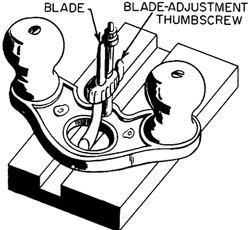
router plane
A plane used for cut and smoothing grooves which have their bottoms parallel to the surface; has a handle at each cease and a centrally located cut tool.
McGraw-Hill Dictionary of Architecture and Construction. Copyright © 2003 by McGraw-Colina Companies, Inc.
plough
(esp US), plow1. whatsoever of various similar implements, such as a device for clearing snow
2. a aeroplane with a narrow blade for cutting grooves in wood
Collins Discovery Encyclopedia, 1st edition © HarperCollins Publishers 2005
Source: https://encyclopedia2.thefreedictionary.com/plow
0 Response to "Plow & Hearth Lancaster Dining Table & Reviews Wayfair"
Post a Comment